
I used to think about learning as only an act positioning oneself in the vulnerability of engaging with what they may not understand. I am beginning to reconsider — to recognize the firmer stuff: resourcefulness, agency, resilience. Consequently, I am leaning more and more into designing experiences that ensure learners feel safe enough to be open but simultaneously disrupted enough to rise to the challenge of having their pre- — and sometimes mis- — conceptions disquietingly confronted (D’Mello et al., 2014). This branching scenario experience built in Articulate 360 Storyline is one manifestation of that new leaning. The design for physicians positions the learner as a pediatrician seeing an eight-year-old patient, choosing from four identically-styled diagnostic paths with no visual cue as to which one will catch what’s actually wrong.
Conflicting Design Elements
Calm-generating
- Multimedia as a cognitive load lightener
- Familiar jargon and protocols
- Minimal text in between user interactions
Confusion generators
- Diverging pathways that don’t invite going back and try again
- Hard choices without guaranteed ROI in the patient’s timeline
- Loads of positive reinforcement for making bad calls like being able to tell families the prescription you wrote is producing measurable improvement while it quietly precludes a time-sensitive diagnosis
Converge — Diverge — Converge, again

After all learners get identical opportunities to access vital information tucked neatly away inside their intake folders, their paths diverge. Of the four initial paths, all are reasonable but only one guarantees the diagnosis that will change this patient’s life. Of the remaining, only one gives the learner a second chance, positioned beside a second chance to go wrong.
When everything is still possible: the four-way fork


When whatever will be, will be: the three-slide terminus
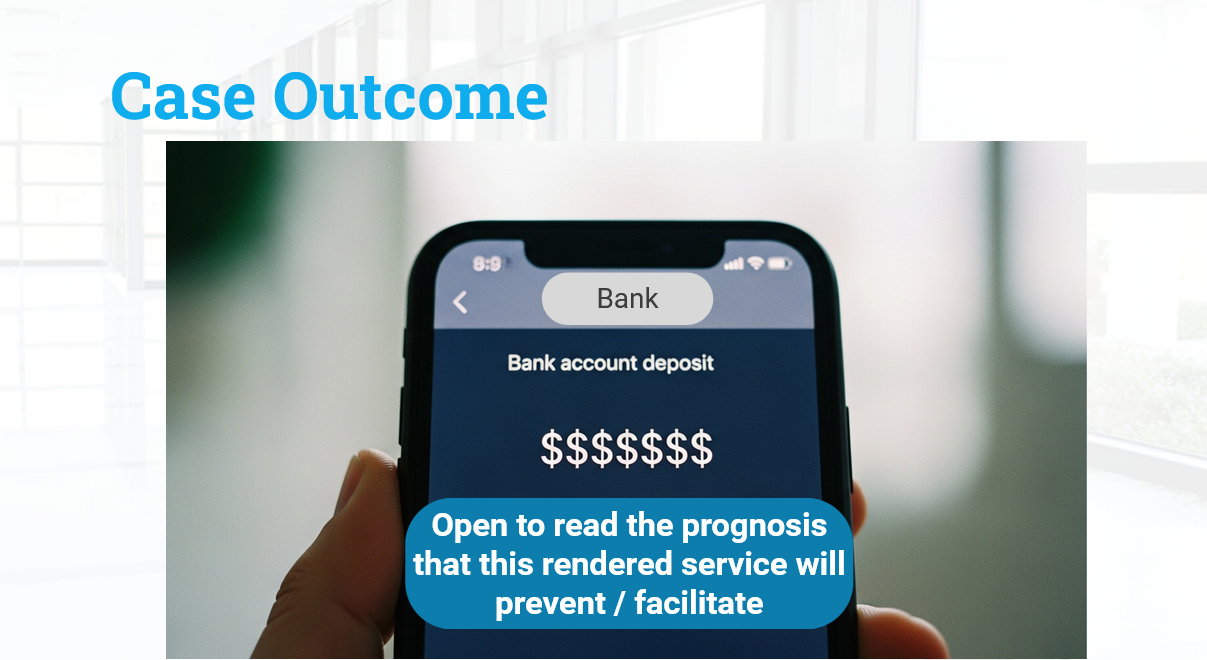
As cognitive neuroscientist Carmen Simon argued on Think Fast Talk Smart (Abrahams, 2026), visuals can carry the 10% of a message learners will retain. Here I allow the visual of any doctor’s ending to carry the pedagogical weight of that ending’s implication: a capital-driven healthcare system does not reroute learners based on their chosen paths because it cannot differentiate between those paths in the first place.
Everyone gets the exact $ame ending —

— except the patient.
Finally, the learner simply learns: they arrive at the realization of all that their correct or incorrect decisions have prevented or facilitated and find no commendation or discipline, no green checks or red Xs. They find out what, for better or worse, will become of this patient in the weeks and years, and increasingly, inevitably — decades — will have been precluded or concluded. Their measurement is silently self-generated by the side on which they locate themselves, relative to the diagonal line of a slash.

This design aspires to verisimilitude at every turn — not just with language or protocols — but by granting learners the agency and responsibility to choose their own real, mostly impossible learning pathways. It expects the psychological resilience required to work past ego, grapple with an authentically difficult task, fail, and go forward not more confident in demonstrated competence but perhaps less confident in the system that does not register mistakes when they trigger with no immediate consequences, no inflection points, no lawsuits, but often with grave patient outcomes, nonetheless. That’s why it needs no SCORM-ing: a nice little spreadsheet with data points all in a row would not just fail to capture the ambiguity this design is meant to surface without resolving — it would foreclose impact. Engaging does not demonstrate simulated performance capacity or regulation compliance. It removes the veil covering some uncomfortable realities and leaves them uncovered, as a means to the end of disrupting future frictionless performance of healthcare that neither produces health nor demonstrates care.
Leave a Reply