
I was just a stereotypical college kid with a part-time job — and no idea that the pattern my brain was about to inaugurate would go on to reappear like cross-sector whack-a-mole across a span of diverse experiences. In truth, before I was designing multi-year change management systems, innovating workflows that cut operational steps in half and then some, or organizing equity campaigns that quintupled representation, I was already the person whose brain would keep doing what I would one day recognize as its signature trick: seeing the solve no one else had even figured out they should be looking for — uninvited, across every system I ever stepped into.
| Loss | Bystanders | Stood | Seen | Gains |
| 50% of tram legs empty | 4 managers 100+ team | 1 month | 1 hour | 0% of tram legs run empty |
One mile from my undergraduate campus, Busch Gardens Tampa Bay sprawled across 335 acres of engineered Africa — lush Sunshine State greenery standing in for the savanna where lions stretched daggered paws, thousand-pound gators sliding past knobby-kneed cypress roots, gorillas in the mist of Florida’s infamous humidity, and the Montu — once the tallest inverted roller coaster in the world — dangling your feet over a pond of Nile crocodiles.
The park was the zoo. The parking lots were the wild.
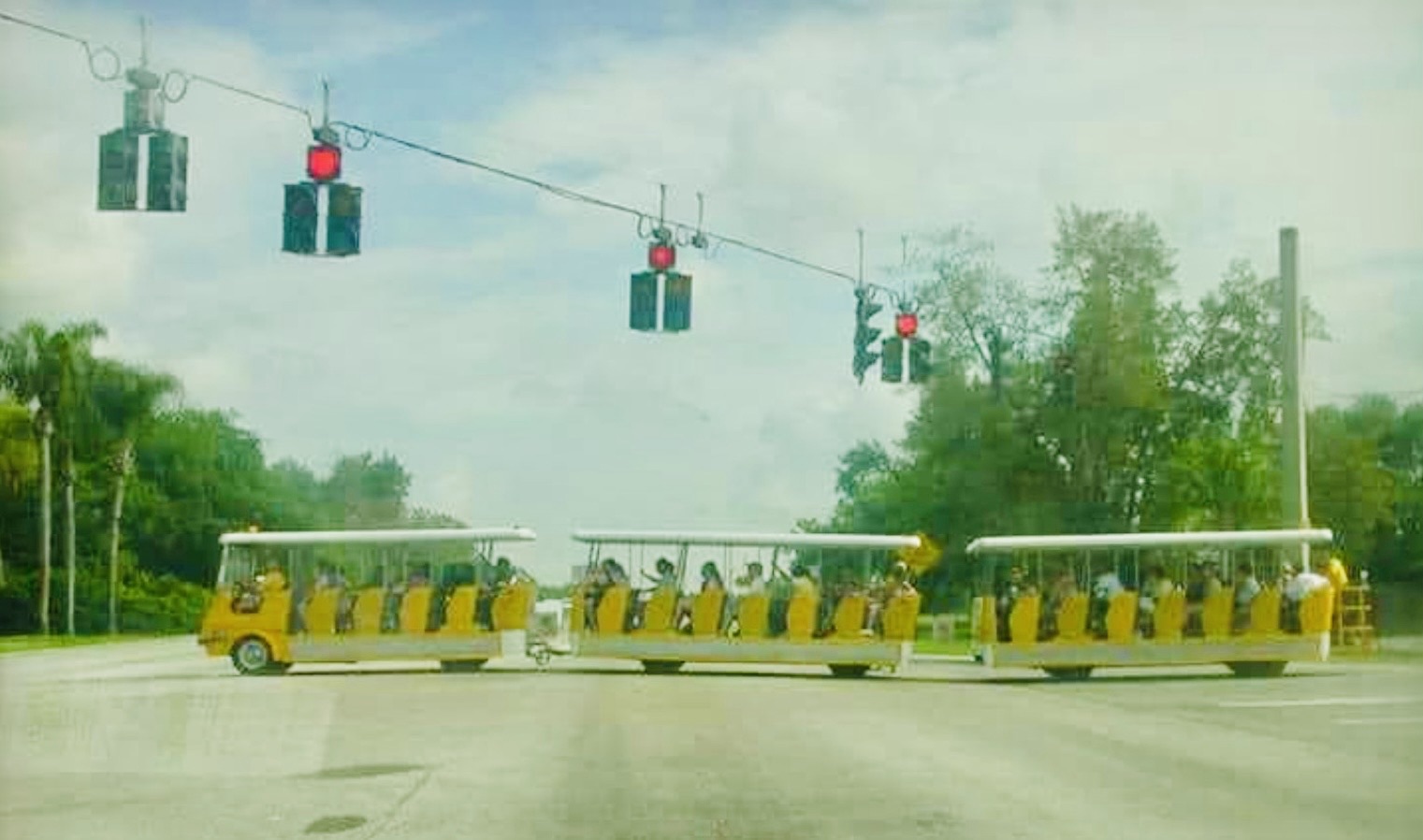
A roller coaster never leaves its track. A tram has no track — and its driver might find themselves suddenly sharing a narrow lane with human beings pushing their sleeping infants in strollers just a hair’s breadth from getting sideswiped. In tidy HR files, we were called Traffic Logistics. In reality, we were in coordinated chaos mitigation.
That’s why we worked alongside city police officers, not park security guards, and why there were platforms retrofitted onto the backs of each tram. Tram driver competency could only be depended upon to mitigate risk up to a certain point and the implications of that limit had already been learned the hard way. Subsequently: the platforms. A partner in a role called spieler could, when positioned on one of these platforms, monitor the entire periphery of the vehicle and everyone on board before, during, and after movement. Spielers were never really just there to spiel — pre-recorded could have covered that. They were really there to support drivers operating unwieldy six-ton machines as they navigated a variety of routes embedded in the most complex, unpredictable system of all, a system that had already proven itself potentially deadly in this context: human crowds. As those spiel platforms were being installed, buttons were being retroactively integrated into each vehicle’s electrical system — the button a spieler pushed twice to signal the driver it was safe to depart, and once to tell them to stop, immediately, no questions asked. I’ll leave you to imagine why.

We all knew this story — though it had occurred before most of us were employed there. Consequently, we also knew that higher guest numbers increased risk exponentially. The bigger the crowds, the longer everyone had waited by the time they finally got to us: their last wait.
Despite all of this, our department’s 4-person management team was made aware of the plan to begin new after-hours Halloween programming. This would mean that we as a department were going to be required to get morning crowds out of the park-fed Main Entrance Tram Stop, called Main, and to Tram Stop 1, called TS-1, where they could exit our vehicles and walk to their own at precisely the same time that we would need to get whole new crowds of guests out of the parking lots-fed TS-1, onto our vehicles, and transported to the Main Entrance Tram Stop.
Management’s solution was to split the fleet: six trams dedicated exclusively to exiting guests, six trams dedicated exclusively to incoming ones.
This meant that if I was driving a tram of exiting guests — mostly families dragging half-awake children — I’d load them at Main, drive to TS-1, and pull up behind whatever tram was already loading incoming guests, hoping none of my passengers grew too impatient staring at that tram stop a mere 50 feet away that they knew full well was the gateway to their cars. Alternately, if I was driving incoming evening guests — mostly young adults in near-frenetic Halloween spirits — I’d load them at TS-1, drive them to the secondary pavilion at Main, and cruise directly past all the waiting families at the primary pavilion, an empty tram passing people who’d been on their feet all day and just wanted to go home.
It went exactly as well as you would imagine. Everyone — literally everyone — was frustrated, agitated, or full-on aggressive. It was a powder-keg, and every time we got through it without a fight or accident felt like the loss of another unit of our certainly finite luck.
On the very first night of deployment, driving my tram up to the traffic light over the intersection that divided the park grounds from the parking grounds, I could simultaneously hear the sardined outbound passengers behind me and see the inbound guests filling the standing room of TS-1 to which we were bound. Tempting though it was, I couldn’t turn around at that light. I pulled in alongside the tram stop and exercised my freedom to turn at least my own head away from the jostling, crashing crowds. Sliding my eyes over Tram Stop 2 in the distance, my brain was a match across flint. I told one of those four supervisors. Then he told his team. Then they told all of us we were doing it.
We would stop splitting the fleet. Every tram would load guests at Main, unload at TS-1, and drive to TS-2 — where incoming evening guests, directed straight past Lots C, D, and E regardless of capacity, would be waiting after parking in Lots F through H. We’d had these geographic resources the whole time. We’d had the gear — sandwich-style custom signage, traffic cones, and fully-trained personnel to leverage them. We just didn’t have leaders who recognized how to leverage them in this new way, or anyone else on our 100+ person team for whom a solution made itself visible.
It made itself visible to me.
Guests with an unusually high risk tolerance — the ones crowds and long waits reliably surface — forced to hold behind safety lines while empty trams glided slowly past them toward a stop they could see from where they stood: 0.
This was the first time I noticed that I saw things differently — that my sensitivity to the wellbeing of users was undulled by the impairing effects of social inertia. That I could literally see what others couldn’t.
I was still a college kid, and maybe that’s why my capacity to interpret the significance of this wasn’t supported by the benefit of a pattern — yet.
At our next department meeting, gearing up for another winter holiday season of slammed status, I was called to the front of the room by my fellow-college-student-supervisors to receive recognition for doing the kind of work that the company usually sent in operations manager making six-figures to perform. Since, despite the company having dropped that ball, we were all enjoying lower blood pressures anyway thanks to the change, they asked me accept their genuine appreciation and a gift card to Sketchers. I did so gladly.
Leave a Reply