
Yes, actually–a magic bullet does exist; no, sorry–it isn’t what they’re trying to sell you.
One Small Bird
The research problem I started with was quite a small bird: autistic patients being mislabeled as “non-compliant” in medical charts leads to care breakdowns. I began looking for the perfect stone and started with a neurodiversity-affirming language toolkit (Ip et al., 2024) A few iterations of the script later, however, I found it — and realized I was aiming at the wrong bird. Ineffective patient behavior documentation seemed to be this vast flock of misattributions and misjudgements, when it could actually be narrowed down to a single cause: describing interpretations of patient behavior, rather than the behavior itself.
Every One
The new objective hit literally all of this kind of bird at once, with 100% accuracy: describe observable behavior, period. Suddenly, the constant gaps in understanding opened between patients and staff by differences — all the differences — became closable with one, simple behavior change already findable in everyone’s job descriptions.
The Other Elusive Bird
Unfortunately for me, deep learning usually requires recursion — and making the same mistake twice.
Before
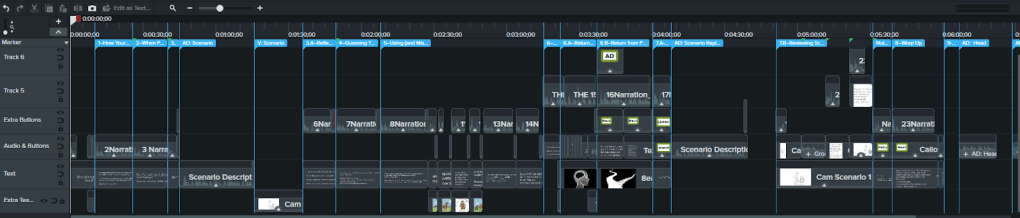
Before, my Camtasia timeline was a mess.
- callouts overlapping during scenarios
- navigation buttons appearing long before they were functional
- text timing based on guesswork
I thought I had no time for these. I’d already sunk more than I could afford, with nothing to show for it, into searching out how-to’s for hiding audio description clips — tidying them away as visually-impaired-user-secret-side-quests.
The Stone
Dejected, I finally paused my search and began what I saw as the post-production phase equivalent of adding image descriptions at the end of a blog post: recording my voiceovers. I finished the first recording and looked at it sitting on my timeline, casting into stark relief the poorly estimated duration of my first scene sitting beneath it.
Several things hit me at once.
What’s to juggle?
First, visually impaired learners would depend on these audio files almost entirely. To these users, the voiceovers literally were the learning. They weren’t aftermarket modifications for the vehicle of my learning design — they were the vehicle.
Secondly, the original foundation track — the script, rendered as a series of text-based slides — were simply a more visually accessible captions track.
Thirdly, I was witnessing the exact same principle I first recognized as a classroom teacher juggling lesson planning and bolted-on IEP accommodations: there was nothing to juggle because virtually every accommodation would benefit virtually every student and so deserved to be nothing short of standard practice.
After
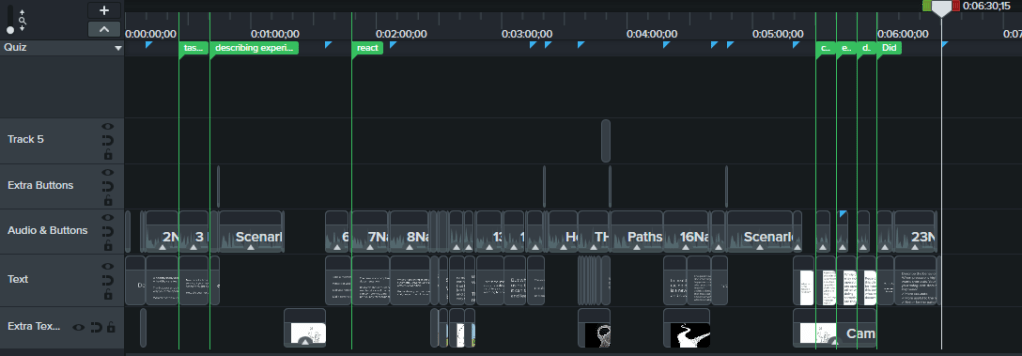
I started a new, empty track and just began filling it with audio clips, in order. When users were about to encounter an image, I recorded a clip describing it and made “Listen” the first navigation option and let sighted users opt out with “Watch.” Then I bolted on the text clip in the track above and the visual in the track beneath. With a timeline organized around the most inclusive track, text, buttons, and visuals all synchronized, incongruencies self-solving before my eyes. Looking back, I would have finished this project in half the time if I’d started here.
The Takeaway
Strong learner experience design is leaving no one out. The two, exclusive birds: a too-narrow learning objective and a design serving some more than others. The one stone: inclusivity.
References
Ip, A., Landerholm, M., & McGowan, S. (2024). Language matters: Transforming healthcare for neurodivergent people. Autism Community Training.
Milton, D. E. (2012). On the ontological status of autism: The ‘double empathy problem.’ Disability & Society, 27(6), 883–887.Vincent, J., Harkry, L., & Hamilton,
L. G. (2024). Creating a diversity climate in the workplace: A mixed methods study into knowledge of autism and attitudes toward hiring autistic people in the United Kingdom. Journal of Vocational Rehabilitation, 61(2), 303–314. https://doi.org/10.3233/JVR-240039
 small MATTERS
Leave a comment